

*Note: this review assumes readers have read books one and two: Aurora Rising and Aurora Burning, and also contains spoilers for Aurora’s End.
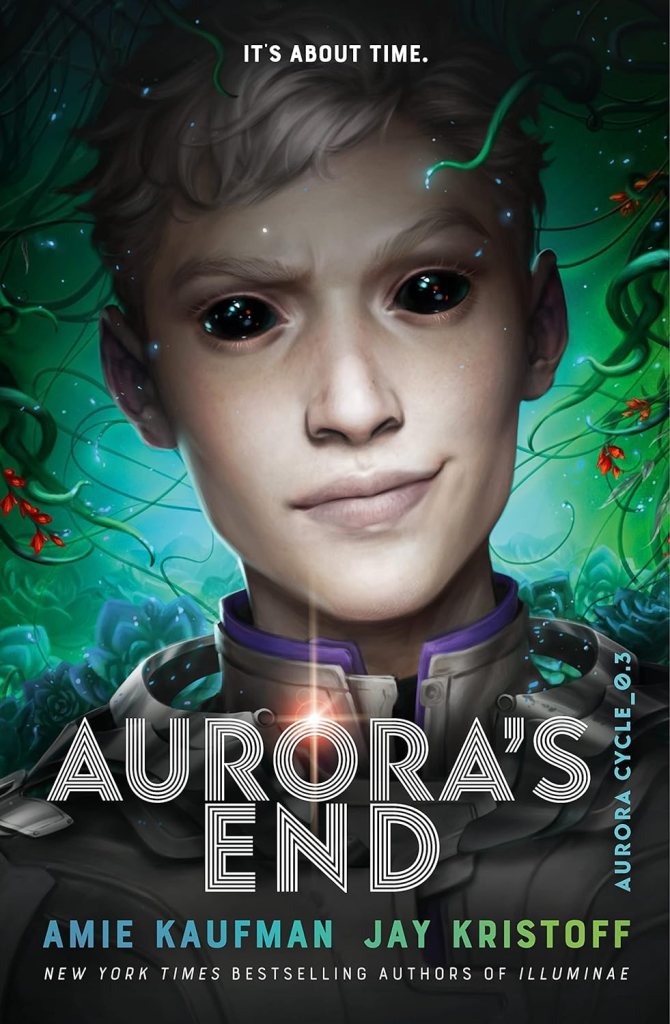
Aurora’s End by Australian authors Amie Kaufman and Jay Kristoff is the final book in the young adult sci-fi trilogy The Aurora Cycle, following on from Aurora Rising and Aurora Burning.
With book two leaving us with a cliffhanger ending and our main cast split up, it’s impossible to discuss book three without giving a lot away.
Where we last left Scarlett, Finian, Zila, Kal, and Aurora, they’d confronted Caersan, the Starslayer and leader of the Unbroken, who was about to destroy Earth. Not only was it revealed that he was also a trigger like Aurora and had used the Eshvaran weapon to destroy his species’ own homeworld, but he is also Kal’s father (DUM-DUM-DUM!). Anyway, with the weapon firing on Earth only to react with an artefact in Scarlett’s possession, something unexpected occurred.
Cue the book’s main shake-up. As was hinted at back in book two, time travel is indeed a factor. We begin with Scarlett, Finian, and Zila having had their shuttle thrown 200 years back into the past, only to find themselves trapped in a timeloop with a short-tempered pilot guarding a deep space research station who quickly resorts to repeatedly blowing them up. As the four of them find themselves reverting to the same point in time with each death, they soon learn that they’re the only ones who remember this, and from here must find a way out of it.
Meanwhile back in the present, we left Tyler on his own cliffhanger following his escape from the GIA’s clutches. Having formed a delicate understanding with Kal’s sister Saedii during their time imprisoned together, she has since saved him and has seemingly begun listening to him somewhat regard to the threat of the Ra’haam.
So, where has that left Aurora, Kal, and Caersan? You guessed it. They’ve been sent into the future. Now twenty years after the attack on Earth, the absence of the Eshvaran weapon and its triggers that were supposed to stop the Ra’haam has created a timeline where the plant-based hivemind has been left to overrun the galaxy. The few survivors who remain are resigned to a lost cause, yet Aurora, Kal, and Caersan are now forced to work together in spite of their conflicts to win these people over and find a way back to the present to prevent this future.
From here the plot jumps between the three time periods to cover each group’s trials. Scarlett, Finian, Zila, and their new acquaintance Nari find themselves struggling to escape the timeloop by collecting clues within the nearby space station over the course of repeated loops, with death after death playing out like a videogame checkpoint.
Tyler meanwhile, being plagued with visions of the Aurora academy being blown up and destroying any chance of galactic unity against the Ra’haam, is desperate to get Saedii and her Human-hating followers on his side. Failing that, the best he can do is try to go it alone.
Aurora’s End is fairly straight forward with its objectives upon establishing each situation. Despite being split up, everyone’s goal is largely the same; get back together and defeat the Ra’haam.
Following the tremendous amount of character growth that book two introduced, much of this is sadly either squandered or goes unused in book three. Aurora and Kal’s relationship has practically mended in a heartbeat despite it seemingly being shattered near the end of book two by the secret of Kal’s father being outed.
Tyler meanwhile suffers from not having many other characters aside from Saedii to bounce off of, though their dynamic has by now reached a very interesting place. Aside from this, there still remains his exacerbated feelings of guilt from having been tortured while in captivity at the hands of Cat, his former friend and lover turned Ra’haam host and GIA operative.
Scarlett, Finian, and Zila’s story offers the most in terms of character interaction, yet the situation they find themselves in arguably works against this. The urgency of it is almost like an itch that leaves the reader frustrated at how long it’ll take for them to get out of it, yet there still manages to be some satisfying and meaningful moments. The best parts come from Scarlett and Finian, whose steady hints of a budding romance in the last book have finally reached their culmination. Zila too is finally given a chance to come out of her shell too in the form of the dynamic that forms between her and the new character, Nari. Additionally, some of the time-travel related questions that were presented in book two start to see their dots connecting here.
Aurora’s End spends most of its time in the thick of the predicaments it leaves its characters stuck in at its onset, yet for much of the story these feel like roadblocks in the way of getting home and stopping the Ra’haam before it can spread across the galaxy. Everyone spends most of their time focused on their obstacles rather than each other or their wider goals. This too highlights the book’s main weakness; the cast being split up. The first two books’ greatest strength was the ensemble’s dynamics, yet this is greatly reduced in book three. It feels as if what needs to be done to wrap up the saga’s plot is fairly simple at this point, yet for the sake of padding, new obstacles need to be delt with to get there.
Book three doesn’t really add all to greatly to this universe’s worldbuilding either, aside from fleshing out the history of Human space exploration and their past conflict with Finian’s people, the Betraskans.
As far as strengths go, the chemistry that this cast has built up across the previous two books is a real point of missed potential here given their being split up, but this doesn’t stop them from making the most of what’s available. Scarlett and Finan were in my opinion the most satisfying part of this book, and despite Aurora and Kal’s relationship having reached a point where there isn’t really anywhere left for it to go, their interactions with people from their past who they’ve reunited with in a bleak and hopeless future does add an interesting new dimension.
Another pro, for some readers at least, is the book’s mix of tones. Scarlett, Finian, and Zila’s situation has a feeling of claustrophobia and constriction about it, as if they’re trying to find their way out of a cave with a collapsed entrance. Tyler’s story has an air of isolation and abandonment. He’s left to soldier on alone despite everyone he’s lost. As for Aurora and Kal, their situation is morbid and depressing. We see what the galaxy ended up as due to their failure, it being the grim realization of what they were desperate to prevent and are now hell-bent on finding a way to go back and make a second attempt at stopping. This future is the story’s best showcase of what is at stake up until now.
If we’re being honest, book three is arguably the trilogy’s weakest entry, and largely uses the momentum and investment generated by the first two books to carry itself. That said, it’s not afraid to crack the whip on the characters and rub salt in the many wounds they’re carrying by this point.
Another strength, albeit an underutilized one, is the fact that we get a chance to see a slightly different side to a handful of the characters, namely Scarlette, Finian, and Zila. We see them sharing vulnerabilities in the midst of a dire situation, which again is arguably what makes their section of the story the most compelling.
Tying in with what I’ve already said, these character’s arcs are largely wrapped up by this point save for Aurora, Zila, and Tyler. Interestingly enough, Saedii and Caersan have their own arcs which, despite feeling rushed and underdeveloped, manage to wrap up in a satisfying way that’s consistent with their characters.
Like with the series’ previous entries, book three doesn’t hesitate to make its characters suffer. Losses, sacrifices, and torture are inflicted and it’s clear that not everyone is getting through this intact, or perhaps even at all. Their youthful optimism has been worn down by the strife they’ve faced. They’re more serious and measured, yet the same sense of humor is still present, albeit a tad muted. For those who found the demeanor of the previous two books’ to be a little too over-the-top or juvenile though, this could be seen as a welcome addition.
One area where book three does outclass its predecessors is in its pacing. The sense of urgency works to its advantage here, and it almost always manages to feel consistent save for a few moments in Aurora and Kal’s story. The jumps between time periods never feel jarring either, and even though our characters are separated by decades or even centuries, there’s still the sense that all these events are happening simultaneously. It’s only towards the end that everything starts to reconverge, and by then we’re very much ready for the story’s climax. By now the themes of found family and rising to the occasion have transitioned into questions of what’s truly being fought for and self-sacrifice in the midst of the final make-or-break test.
All I’ll say about the ending is that it is merely… satisfactory. Yeah, I think it could have been a good deal better, but it’s ultimately not a disappointment.
My thoughts on this book are probably pretty clear by now, so I’ll not overdo my wrap-up. Aurora’s End didn’t quite live up to my expectations, but it still gave me a decently satisfying conclusion. It wasn’t quite as fun to read as the first two books, but overall, this trilogy was deeply enjoyable. As I’ve stated, not once during my reading of these books did I ever want to put them down. My praise may sound generous to some, but I think I’ve also been a bit of a harsh critic in the course of these reviews as well, So I guess we can call it even.
In the end, I’d still strongly recommend these books to any fans of sci-fi or YA fiction. They’re a lot of fun to spend time on, though by the end you’ll be adequately satiated.
 Benjamin Kirkby