

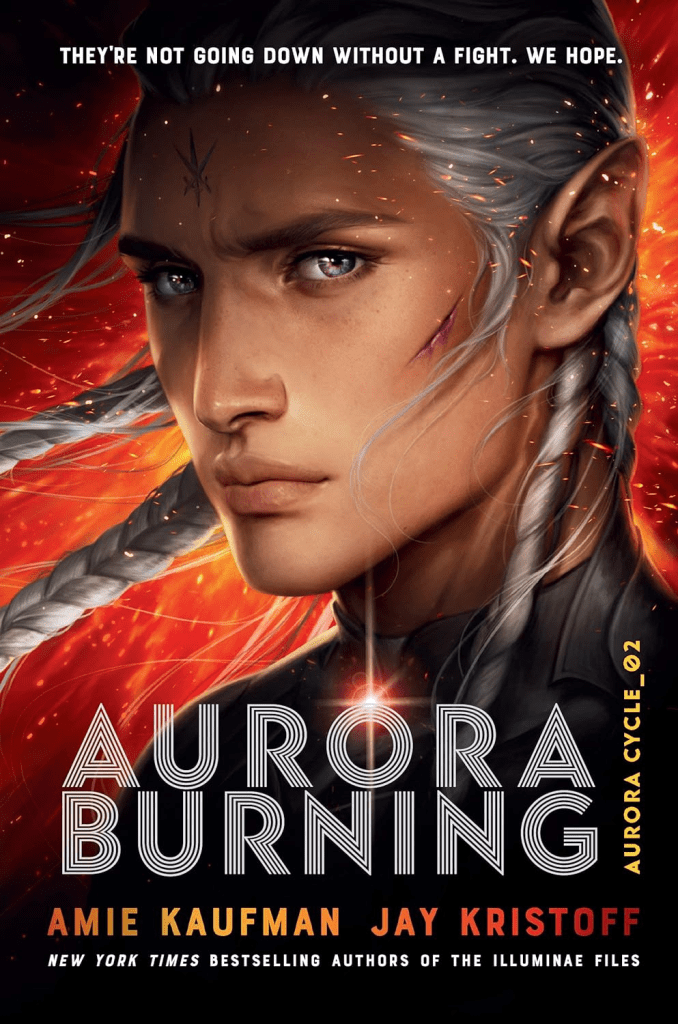
*Note: this review assumes readers have read book one: Aurora Rising, and also contains minor spoilers for Aurora Burning.
Aurora Burning by Australian authors Amie Kaufman and Jay Kristoff is the second book in the young adult sci-fi trilogy The Aurora Cycle, being the follow-up to Aurora Rising.
Following the previous entry’s conclusion, squad 312 (Tyler, Scarlett, Finian, Zila, Kal, and Aurora) are still on the run, though now with the knowledge of who is hunting them and why. The Earth security agency GIA are secretly the puppets of the Ra-haam, a parasitic, plant-based hivemind intent on assimilating the entire galaxy. What is it after? Aurora. Preventing its return, we now know, is the reason she was selected as a ‘trigger’ by the extinct Eshvaran, yet the full demands of her task still remain unclear.
Now falsely accused renegades, our heroes have since found themselves stranded and seeking refuge in the dodgy spaceport of Emerald City, a place not nearly as idyllic as its Wizard of Oz namesake. The squad are forced to keep their heads down as they attempt to follow an uncertain trail of breadcrumbs. Yet, it seems the top heads back at the Aurora Legion (Adams and de Stoy) may still be on their side, having relayed a secret message leading them to what appears to be a pre-planned cache of strange yet seemingly trivial items, along with a way off Emerald City. But how could this have been planned for, and many years in advance at that? Is it predestination, time travel, or maybe… both?
Whatever the case, the key to finding out how to defeat the Ra’haam now lies in tracking down the Esvaran probe that made contact with Aurora hundreds of years ago while she was still in cryo-sleep. Our squad’s next goal? The ship she was found on and its black box, now on their way to a scrap auction.
But despite having an objective in sight, it turns out that the GIA aren’t the only ones hunting them. A militant faction of Kal’s race (the Syldrathi) known as the Unbroken are also Hell-bent on seizing Aurora for reasons yet unknown. During a run in on Emerald City, we learn that the one leading this campaign is Kal’s estranged and utterly ruthless siter, Saedii.
Our characters and their dynamics have evolved since book one, having bonded over the trials they’ve faced. Aurora has steadily grown more confident despite the overwhelming burden she is faced with, seeking support and comfort in Kal, whom she formed the beginning of a romance with. Kal meanwhile, ever distant and stern, may still be holding onto a secret he hasn’t shared, a fact exacerbated by the reunion with his sister.
Tyler and his sister Scarlett are still grappling with the loss of Cat, their long-time friend, who was assimilated by the Ra’haam at the end of the last book, Tyler especially given the unresolved romantic feelings they held for each other that were only truly realized at the very end.
Zili is still her cold and emotionally closed-off self, yet by now we’re beginning to see layers being shed as she grows to trust her squamate more, hinting at a scarred person who does indeed feel something. As for Finian, we begin to see his mask of humor and sarcasm start to crack as he steadily grows more comfortable letting down his guard and being open about his vulnerabilities.
As the story progresses, the squad survive close calls, finding themselves in the crossfire of opposing forces on multiple occasions. As their enemies descend upon them, the urgency of their mission threatens to divide their paths.
We learn more about the history behind Kal’s people and the war they fought with the Humans that claimed the life of Tyler and Scarlett’s father. The Unbroken, it turns out, were responsible not just for his death and prolonging the war, but also the destruction of the Syldrathi homeworld at the hands of the Unbroken’s leader, Caersan, AKA the Starslayer. The Humans and the Syldrathi who had made peace with them have ever since been the Unbroken’s sworn enemies.
The full gravity of Aurora’s task is also given greater focus, particularly as the book’s second act rolls around. We see her struggle with honing her powers as well as her frustration with what the Eshvaran have demanded of her and why. To truly fulfil her role as a trigger she not just has to master her abilities, but also use them to wield an ancient superweapon. Greater still though are the sacrifices that await her. Amidst all this, we see her lean on Kal all the more for support, seeing the two grow ever closer during their time together.
Moving onto the book’s overall pros and cons, I found Aurora Burning to be a sharp improvement on its predecessor. In my review of Aurora Rising I said that the characters and their personality were what really made the book shine, but book two streamlines and springboards off of this to reach a much greater height. They’re each still their recognizable archetypes, but we now get to see a nuanced and layered side to each of them.
Tyler is still the brave leader, but his grief over losing the woman he realized he loved only too late has seen cracks begin to form in his composure. His sister Scarlett still remains bold and confident, yet the rising threat of the unbroken has dredged up old wounds over the loss of her father. Kal’s broody, guarded exterior has steadily begun to soften as he grows to find a sense of belonging and purpose among his squad, as well as through his relationship with Aurora. A particular revelation is Zila, who is now given chapters of equal length to the other characters, as opposed to book one where her chapters typically consisted of a few brief sentences, either for dramatic or comedic effect. We learn a lot more about the dark past she carries and why she is so unemotive and socially awkward. Finian is the character who has arguably changed the least, though we start to get a more honest perspective on his insecurities around his disability and the pain and isolation it has caused him. As he grows closer to the others, we see a more caring side to him that’s quick to offer support. Aurora by contrast sees the most growth, both since the last book and in the course of this one, going from scared and clueless to confident and determined, being near unrecognizable by the book’s end.
Despite all this, the story makes several bold choices on what trajectory to send each of these characters down, which in some cases may seem frustrating. By this point we have a very good idea of what their demons are and what they each need in order to round out their growth in a satisfying way. This is all done especially well, with the mistakes and strife the characters experience constantly enticing the audience to keep reading. Aurora Burning is most definitely not afraid to make its characters suffer to a much greater degree than book one, either through torture, grief, betrayal, loss, or hopelessness, and this greatly works to its advantage.
As with book one however, a notable flaw that book two has is in its pacing, particularly in the second half. The first half expertly balances action, tension, and moments to pause and breathe in a way that never ceases to satisfy. Things get very bogged-down in the second half, ultimately leading to yet another climax that feels abrupt and jarring in how quickly it escalates. Furthermore, the story throws out a number of plot twists during the second half which, while not poorly set up, all feel a bit too close together to truly deliver on impact.
Aurora Burning retains the same youthful charm and near-cartoonish sense of humor, though it is much darker and more serious than the previous entry. It’s not afraid to be camp and gratuitous, but this only serves to lull the reader into a sense of comfort before blindsiding them with one sickening gut-punch after another. It also manages to somewhat smooth down some of book one’s more cringe-worthy aspects, notably the quirkiness factor of some characters. The same themes of found family and rising to the occasion are still very much the story’s focus, but now in a way that attempts to truly test their limits.
As much as I enjoyed this book, I still had my issues with it in ways that other readers may likely share. I’ll not point to where or why for the sake of avoiding spoilers, but there were one or two moments that made me want to hurl the book across the room. Still, this was made up for by moments that left me grinning from ear to ear like an excited fangirl.
In conclusion, what I will say is that if you liked Aurora Rising then you’re going to really, really like Aurora Burning, though to say love might be going just a little too far. The authors have clearly taken a good, hard look and what could be improved from their previous entry, and while not a perfect second attempt, book two is easily a step-and-a-half up from book one. It’s smarter, darker, and bolder, even if it doesn’t quite fulfil the ambitions it sets for itself. As with Aurora Rising, my inability to put this book down not only persisted but felt even stronger than before.
As a final word though, the story’s conclusion will leave you desperately hankering for the trilogy’s final entry, Aurora’s End.
 Benjamin Kirkby