

*Note: this review contains minor spoilers.
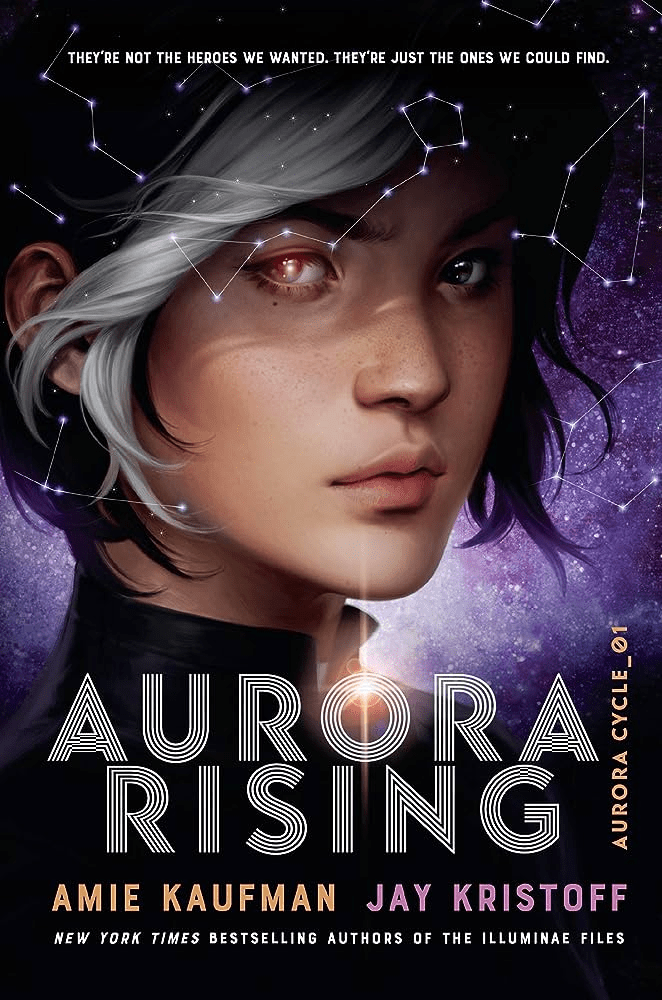
Aurora Rising by Amie Kaufman and Jay Kristoff is the first book in the Aurora Cycle trilogy.
What readers are signing up for here is a young adult sci-fi story set roughly three hundred years into the future. The setting has all your typical space opera window dressing; spaceships, aliens, interplanetary conflict, and so on, along with an extinct elder civilization and the threat of the galaxy’s end thrown in for good measure. All fairly tried-and-true stuff.
The story is told in first-person present-tense through the perspectives of its main cast; a squad of six 19-year-old academy graduates who’re part of a paramilitary peacekeeping force called the Aurora Legion; Tyler, Scarlett, Finian, Zila, Cat, and Kal. Aurora, or ‘Auri’ for short, is the book’s seventh character; an outsider who the plot largely revolves around.
We begin with Tyler happening upon a derelict ship during a late-night joyride that’s been missing for two centuries. Finding Aurora, the only passenger still alive, in cryostasis, he almost gets himself killed rescuing her, which results in him missing the academy draft the next morning; a big deal for Tyler because he’s their top student. Normally, this would give him first pick of the academy’s best students for his squad upon graduation, but now he’s stuck with the dregs nobody wanted.
Tyler’s not-so-preferred squad now consist of his twin sister, Scarlett; a social butterfly with a nonchalant attitude toward work and a revolving door of boyfriends, and his childhood best friend, Cat; a hard-edged pilot with unresolved feelings toward him, both of whom deliberately held themselves back to end up with Tyler. The rest of the crew include Zila; an emotionally closed-off genius with no social skills, Finian; a Betraskan (alien) with a disability that requires an exosuit for him withstand gravity and an inadequacy complex which he hides behind a veil of humor, and Kal; an unfriendly Syldrathi (alien) from his species’ warrior cast who have earned themselves a bad reputation.
Now, despite the fact that we’re told that these characters are the bottom of the barrel, they’re all smart, reliable people who’re good at their jobs. Each of them just seems to have one big flaw that everyone else has held against them, which they’re all carrying around like a weight.
It’s only once the crew are in the middle of their first mission that they find Auri has stowed away with them, and it’s soon revealed that during her 200-year cryo-sleep an ancient alien probe saddled her with a mix of psychic powers and apocalyptic visions. We also learn that she’s being hunted by a shadowy government intelligence agency who keep their faces hidden. On top of this she’s also still grappling with the loss of her old life and everyone in it.
From here the plot largely plays out as a cat and mouse game within the galaxy’s seedy underbelly, as the crew spend a lot of time hiding, sneaking, and trying to hunt down clues about the bigger mystery that’s attached to Auri. Where did this alien power of hers come from and what is its purpose? It’s not until the book’s climax that we find out just how monumental the threat to the wider galaxy truly is.
So, putting the plot aside and moving on to the book’s pros and cons, Aurora Rising’s first major positive is its characters. Their personality really leaps off the page, big time, almost to a borderline overdone capacity at certain points. With that being said, it is YA novel, so what do you expect? There’s an almost cartoonish exaggeration to these characters at times, yet it’s comfortingly reassuring, and you always feel like you know exactly where they each stand on something, what they’ll most likely say, or how they’ll act. Nothing they do is ever out of character. Who they are, where they’re coming from, and what moves them is communicated brilliantly, and we’re made to feel a real sense of empathy toward them. That said, some members of the cast are definitely given more spotlight than others, and some of them have more expressive personalities.
One fault I found, though I suppose it’s forgivable for the genre, is that each member of the cast is very archetypical. Tyler is the brave, example-setting, boy scout-esq leader; Kal is the broody, mysterious outsider; Scarlett is the sassy, fabulous, queen bee; Cat is the rude, cantankerous, tough girl; Zila is the emotionless, socially inept, quiet one; Auri is the anxious fish-out-of-water; and Finian is the sarcastic smartarse who uses jokes as a coping mechanism.
All this isn’t to say that these characters aren’t layered individuals with flaws and issues to deal with, though by the end we’re still left scratching our heads a bit about each of them and where they’re going (first book in a trilogy though, remember). With some characters we’re given enough to understand them deeply, with some we’re not quite given enough and left wanting more, and with some they’re still a complete enigma by book’s end. None of them are perfect though, even Tyler who, despite being the ‘golden boy’, comes across as a bit of a Mary Sue. Still, that’s not to say he hasn’t made mistakes and suffered from them. They’ve definitely all got a scare of one kind or another.
The book’s pacing is also somewhat inconsistent. Ironically, it’s when the plot is at its most slowed-down that the tension leaves you at your hungriest. At points where events happen quickly though it becomes harder to feel enthralled or pay attention. Act one is a tad wobbly, yet act two is where the story really shines, and the book’s climax, while powerful, is somewhat chaotic and abrupt.
The use of the science fiction setting is tastefully balanced. The worldbuilding, while nothing amazingly original by sci-fi standards, is colorful and intriguing, while not being overdone or convoluted. It doesn’t throw technobabble at you relentlessly, and even when things like tech, science, or space-magic-esq elements are used, it’s simplified enough not to disrupt the flow, nor does it ever get its head stuck up its own backside ala Star Trek.
A lot of this is probably my own preferences speaking, I should say. I’m the kind of guy who’s drawn to sci-fi more for the cool spaceships and aliens rather than the great philosophical quandaries arising from technology or cosmological mysteries. Refreshingly, Aurora Rising doesn’t take itself too seriously or ask its reader to do so either. It’s mainly a fun and exciting romp with a focus on found-family, maturation, and responsibility.
Additionally, for a YA book, it certainly isn’t afraid to push the envelope with what it can get away with in terms of mature content. It never pretends that sex, drugs, violence, and genocide aren’t very real parts of the world, nor does it skirt around them. Additionally, once we are finally introduced to the saga’s main big-bad, there’s a definite air of skin-crawling horror about them, literally.
The story’s mix of tones is a nice touch too. There’s plenty of light-hearted humor that errs on the side of juvenile, which you could say reflects how well the book knows its target audience. At other points though, the story will take a gut-wrenching left turn that leaves you shocked, sickened, and reeling, which I mean as a complement. The tonal range and fluctuation may just be a byproduct of the book being co-authored by two people rather than a single author though. It’s not the first time that Kaufman and Kristof have written YA sci-fi before however, having previously pooled their talents on The Illuminae Files.
This book isn’t going to please everyone, I should say. There’re times when the writers try to inject a quirkiness into the characters, and it largely comes across as cringy. There were times where I would have appreciated just a little more maturity or self-awareness from some of them. To some readers, this book’s approach may seem low brow or passe. The way that certain character dynamics and story beats play out is also somewhat predictable at times. I’ll not give anything away, but you may end up rolling your eyes in a few places.
In conclusion, I’d recommend this book to anyone who appreciates sci-fi that isn’t too convoluted or takes itself too seriously, but still delivers on emotional impact and lovable characters. As I’ve stated, this is primarily a found-family story at its heart. It won’t demand too much of you, and some of the tropes it leans into are a bit same-old at times, but I found a certain snug comfort in this, like a new recipe with all the same ingredients.
Aurora Rising certainly isn’t the most intelligent work of science fiction out there. It’s no Battlestar Galactica, but then again, it’s not really trying to be. The maturity of the book’s target audience is an important factor. Still, a lot of adults apparently like reading YA books for their more easily digestible delivery, so I’m told, and I’m certainly inclined to believe this. It’s honestly rare that I find a book I can’t put down upon starting, yet shockingly, this was one of them. What’s most likely to hook you as a reader is that you will fall in love with the characters and want to see where their stories go. Fortunately, that’s what sequels are for.
Follow-up reviews for both Aurora Burning and Aurora’s End yet to come.
 Benjamin Kirkby