

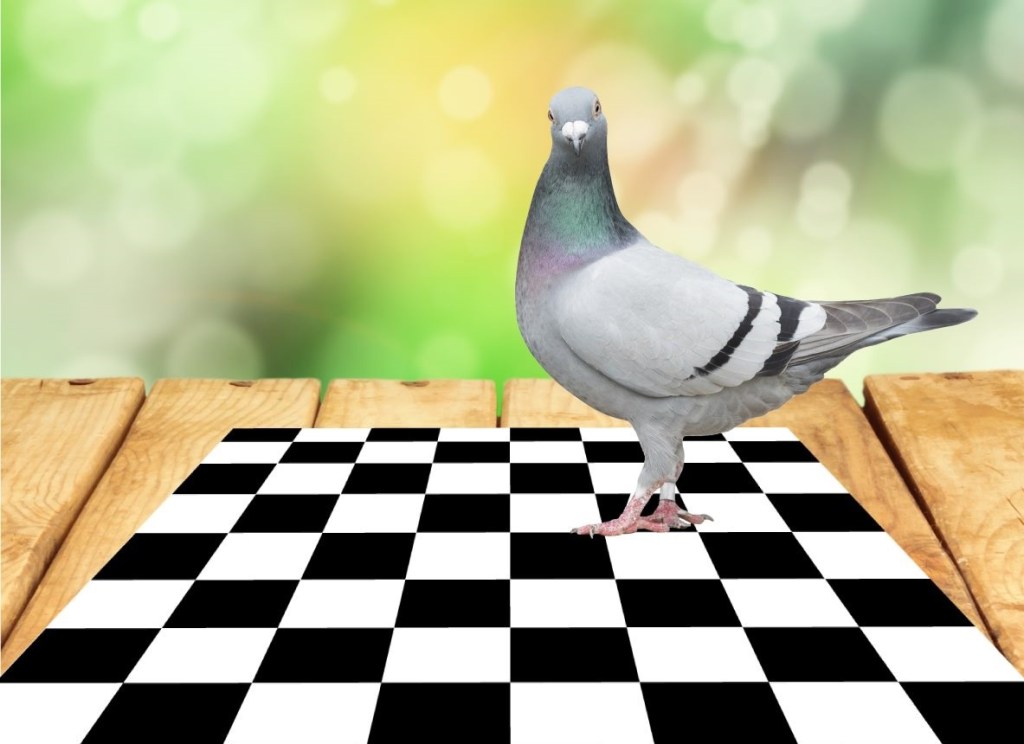
“Arguing with an idiot is like playing chess with a pigeon. No matter how skilled a player you may be, the pigeon will simply knock over the pieces, leave its mess on the board, and strut around as if it has won.”
I remember my grandfather once saying that to me, but until recently, I never truly understood what he meant.
Not too far from where I live there’s a park that I like to visit. It’s nice to just sit there on a spring day taking in the warm sun after a cold winter. There’s a calming simplicity in just people-watching sometimes, imagining the stories behind each of them as they pass by. The lady walking a pair of dachshunds who’d stop every ten meters to boisterously playfight with each other like a pair of teenagers. The man with a prosthetic leg wearing some kind of military beret, walking with a cane that bore a chrome skull on its pommel. The group who holds their Tai Chi classes out on the lawn every Saturday.
A lot of the more senior members of the community have often liked to frequent this park. It’s my experience that they’re always more willing to say hello or strike up a conversation, a skill us younger generations have sadly neglected, it often seems.
One day, as I sat at bench with the sun at my back, reading my copy of The Philosopher’s Stone, a man diverted the course of what seemed to be his daily stroll to pass close by me.
“Good day for it,” he commented with an amused grin.
“Yeah. The weather’s just right this time of year,” I replied.
“Mind if I sit a bit, just to rest these old legs?” he politely asked, to which I nodded. I quickly remembered that I’d seen him here before. He looked to be at least in his sixties and was today wearing a curious tartan flat-cap with a red and white pom-pom on top.
“Nice hat you’re wearing there,” I commented, putting my book to one side.
“Yes, my daughter found it in an op shop,” he smirked affectionately. “I noticed what you’re reading by the way. She loves those books. I remember reading them to her when she was little.”
I gave a chuckle. “Yeah. I think that’s how I got started on them too before I was old enough to try reading them myself. They’re always fun to revisit occasionally. I’m up to the bit with the chess game.”
I soon learnt that the man’s name was Neil, and from there it didn’t take us long to start talking about the game of kings itself and how perfect a setting like this would be for playing it.
“Maybe I should bring a board next time?” I eventually suggested as Neil eventually got up to be on his way again.
“I’ll stop for a bit longer if I see you again, perhaps,” he nodded.
It didn’t take too many more visits to the park before our paths eventually crossed again, and as we’d discussed, I’d come prepared.
Now, I’ve always considered myself pretty good at chess, but it wasn’t until we’d sat down and started playing that I learned that Neil’s grasp of the game’s rules was a good deal more tenuous than I’d been expecting.
Several moves in, it seemed he was moving his pieces with no concern for strategy, being more interested in treating them as independently minded beings acting spontaneously. As much as this made things easier for me, I was curious why he was doing this. I deliberately squandered opportunities to secure an advantage, hoping to prolong the game a gleam an insight into some kind of method in Neil’s madness.
Is he playing a bigger game than I can see here? I began to wonder. Perhaps he hopes to return and play future games with me and is somehow trying to condition my expectations of how he thinks.
Just when I thought I’d figured him out though, Neil threw an even more unexpected curve ball, moving his pawn in a crooked path.
I frowned in confusion. “Pawns can’t move like that,” I stated. “That’s against the rules.”
Neil tilted his head with a cocky grin. “Whose rules might those be?” he said, stroking his chin. “Does the pawn, an obedient little foot soldier, simply follow rules because it’s what the king commands? What if the pawn decides it doesn’t want to follow these rules, and wants to do its own thing?”
I shook my head in perplexed disbelief. “Those aren’t the king’s rules. they’re the game’s rules,” I insisted. “If we don’t follow them, the game doesn’t work.”
Neil’s eye narrowed in fascination. “Aren’t we all just pawns agreeing to follow set rules?” he stated. “What’s to stop us from breaking them any time we want and playing or own game with our own rules?”
“Ah, consequences maybe?” I said, raising an eyebrow it his audacity.
“And what consequences, according to this game’s rules, await my pawn now that it has violated them?”
I found myself puzzled by his question. “I… don’t know,” I answered. “But still, you can’t just bend the rules whenever you like, otherwise the game doesn’t work. You can’t play the game properly if the pieces aren’t confined to their specific roles, and I guess, if you can’t have a game, then the pieces are out of a job.”
“Exactly,” Neil boldly declared. “They need no longer sacrifice themselves for the sake of the king and his conquering ambitions. Their purpose can instead be their own.”
I was beginning to feel like I was beating my head against a wall, but as I tilted my head down with a frustrated sigh, Neil gave a chuckle, moving his pawn back to where it had been the move prior.
“I won’t press the matter then,” he said, moving his hand to a different piece, his rook. Lifting the piece though, I was again perplexed as he brought it down, not on anther square, but on the table next to the board.
“What was that?” I questioned, stiff-browed.
“The rook is a tower; a watch post from which the lower ranks can be surveilled to ensure their obedience. If the policing apparatus should be removed however, what then remains to ensure the pawns are following the rules?”
Seeing the futility in trying to make a similar point as before, I gave a smirk. “You know, if you want to effectively take your own piece, it’s only going to make my job easier,” I said, moving my bishop.
“Ah, the bishop,” Neil smiled. “He who preaches the word of what is right and wrong to the masses. The elite clergyman, second only the royals themselves.”
As frustrated as I was with Neil’s defiance in the face of convention, I was beginning to find a certain charm in his whimsical characterizations of the pieces and what they symbolized. I’d already taken his queen earlier in the game, which had prompted him to declare that I’d stolen away his lady love and that his chivalrous knights would ride forth to avenge her honor. As charmingly quaint as I’d found his poetic metaphor, I probably should have seen where he was going with it in hindsight.
With each further move, I continually found myself scratching my head. Is this what my grandfather meant about playing chess with a pigeon? I wondered.
Confounding as the eccentric old man’s interpretation of the game was, I continued to find fascination with his choices. There was an authentic passion in them. I began to wonder if his words about the pawn and its defiant rule-breaking were something of a personal statement; a declaration of his own disregard for convention. One thing had definitely been clear since the start of our game though. Niel seemed to have the cockiness of a man who knew he was winning.
As the sun began to dip lower, I stared at the chaotic and disordered battlefield our chessboard had become. I didn’t know what I was trying to accomplish anymore, nor what Neil’s true intent was. Even if I did still try to win, I felt he’d find one last nonsense-bomb to deploy. Had this been his plan all along? I wondered. To wear my rationality down with hogwash.
Still wanting to see what he’d pull next though, I played on, with my bishop and rook eventually checkmating his king.
As Neil lay his king on its side in defeat, he smirked with satisfaction, as if I’d somehow made a monumental blunder that had handed him the victory.
“What’s so amusing?” I asked.
“My friend, you may have won the battle, but to what avail? Tomorrow these pieces will be set up again right back where they started, and your victory over me will be a thing of the past.”
I found myself left without a response. He did indeed have a point. What did I have to show for my superior skill and devotion to the rules? It wasn’t as if the outcome of our game had changed anything. I almost began to feel humbled. I’d won the game, yet it felt like Neil had been the one who’d schooled me, rather than the other way round. Smiling, I reached out to shake his hand. “Well played,” I declared.
As I packed up the chess set, an odd sense of enlightenment seemed to hit me. All day it had seemed as if Neil had been dancing circles around my rigidity, meeting my disciplined logic with carefree whimsicality.
Giving Neil a nod upon our parting ways as the afternoon wound down, I left with a newfound admiration for him. He’d seemingly acted the fool all day, yet beneath his veil of obstinate dismissal, I sensed an unconventional wisdom of sorts. Neil wasn’t quite the blissfully ignorant pigeon he’d presented himself as during the course of our game, but a man who refused to let the way he saw the world be dictated to him. He chose to see what it could be, rather than what was, and certainly didn’t lack for imagination in that regard.
Whether he was self-aware about it or willfully dismissive didn’t seem to matter, I felt. He’d learned to be happy with it, and if our game had taught me anything, it was that people like me certainly weren’t going to be bursting his bubble any time soon.
 Benjamin Kirkby