

A lazy sci-fi writer can get away with just about anything, given enough technobabble.
“Captain, the quantum doof-doof drive is about to implode. Orders?”
“Quickly men. Try using an inverse nonsensicality field.”
You get the idea. For writers who care about achieving a sliver of believability in a genre littered with preposterousness though, it pays to do a little homework first.
The biggest problems with real science though are A. it doesn’t always give us the answers we may have been hoping for, and B. for most of us, doing science is hard. Believe me, I’ve been there. ‘Handwaving’ can sometimes be a way around this problem, but if you’re too vague about it, it can often come off as a bit sus to your audience, which is why it’s often paved over with all-too-common sci-fi gobbledygook. “Reverse the polarity of the quantum flux” yada, yada, yada.
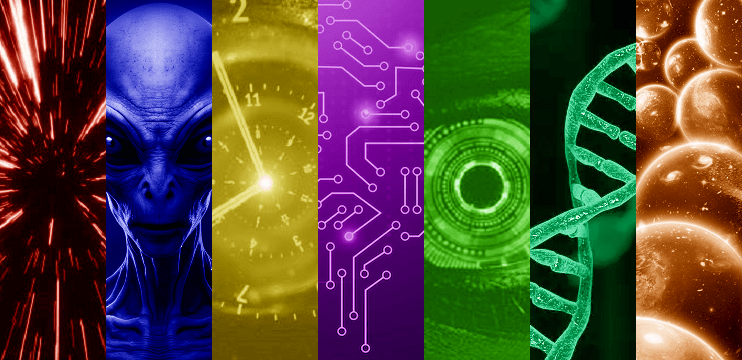
So, how can we streamline the process so we can get onto the fun part of writing about spaceships, robots, aliens, time travel, and so on? Well, from here I’ll outline seven common sci-fi elements and offer my thoughts on how to not do them badly.
Spaceships
Arguably the most quintessential of sci-fi elements, spaceships are something the genre has got a lot of milage out of this trope over the years, whether for exploration, warfare, or postal service. If you’re crossing distances spanning light years, you’ll need to answer the question of how your ship gets around the light barrier when it comes to travel time. Warp drives or wormholes, or either of the two by any other name, are fairly common solutions, but to give your chosen method a little more credibility, you might consider looking into what scientific principals support this being plausible, what kind of power source does it need, and does it run into problems regarding the flow of spacetime? Furthermore, what are its defensive measure and how do its weapons work? These are all things to consider before putting peddle to metal in your fancy new space hot-rod.
Aliens
Being pretty much ubiquitous as spaceships, extraterrestrials’ prevalence in sci-fi is understandable given the possibilities that emerge. Whether they’re tentacled nightmares or something a bit more human-actor-capable, there’s a few pitfalls to keep in mind. Depictions of aliens have often mirrored real-word cultural attitudes, and this hasn’t always been done quite so tactfully. Beware the trope of ‘hats’ where an entire species is defined by a single characteristic such as being war-like, money-grubbing, tech-savvy, or sex-fiends. Additionally, it may also pay to show how a species’ biology and culture reflects the environment they’ve evolved in, whether it’s high gravity, sub-zero, human-toxic, or radioactive. If you want them to look and act more human-like, you may want to have an explanation for this at the ready, be it convergent evolution, a precursor race seeding a common form, or something else entirely. While you’re at it, an explanation of how everyone can understand each other’s language may also be worth a sentence or two here and there.
Time Travel
As exciting as it might seem hop in at out of time wherever you like, visiting pre-revolutionary France, the building of the Pyramids, the age of dinosaurs, or the far-flung future, you should always start by asking if it’s worth all the problems that are likely to crop up. Time travel as a concept opens something of a pandora’s box, which is why its key to determine the rules it operates by. What makes it possible? How do timelines behave; branching or looped? How do you approach the question of ‘the Butterfly Effect’ (go look it up if you don’t know)? How do address paradoxes? Just saying, it might be worth considering the consequences before you accidentally go sneezing on some bug in the Jurassic period.
Artificial Intelligence
AI is already becoming especially prominent in the real world, so if you’re choosing to write about it, there’s at least the advantage of it being topical. Of course, the whole ‘killer robots Hell-bent on wiping out humanity’ approach has been done a million times at this point, though then again, we may yet come to wish we’d listened to those stories in a couple more decades. With this said, if you’re wanting to go after the dangers of AI, an even richer vein of possibility might be the question of how humans could misuse it in malevolent ways. Using it to spy on, regulate, and subjugate the populace, for example, or having it fan the flames of social division. On the other hand, there’s also the benevolent AI approach, where we use it to solve problems like environmental destruction or resource distribution. It’s also worth looking at present-day trends and discussions about AI if you’re wanting to ask the important questions on this topic.
Cybernetics
When most of us think cybernetics, we probably picture robotic arms or telescopic eyeballs with infrared vision. There’s always plenty of milage in exploring artificial additions to the human body, though arguably there’s far more potential in exploring mental enhancements as well. What if we were to invent a brain chip that essentially serves as a supercomputer add-on to a person’s mental abilities? As handy as it might be to have a calculator in your skull though, or the means to learn a new language as easily as downloading a software update, it also has the possibility to go down a scary rabbit hole. Where do we draw the line between person and machine? Could AI take control over people through their artificial hardware? Could I replace my thumbnail with an in-build bottle opener? Who knows.
Genetic Engineering
When I hear a term like CRISPR, I think of the slot in my fridge where the vegies live. For anyone interested in writing sci-fi where making custom edits to human genetics is a reality, it might just be worth reading up on for some ideas. Another field of interest may also be synthetic virology, but here too the consequences of conducting research into these field without regard for safe and responsible practices holds some very real dangers, or some really great potential for sci-fi horror stories. Whether it’s eugenics, mutant plagues, mass sterility, or bacon that grows on trees, biotechnology offers fertile ground in the way of sci-fi storytelling for anyone willing to do some homework on cells, genes, and the new techniques that are being used to fiddle around with them.
Alternate Dimensions
Similar to time travel, the idea of parallel universes and multiverse theory offer perhaps the most open-ended array of possibilities of any sci-fi concept. Sure, there’s plenty of predictable explorations of this idea already like ‘what if the Germans won WWII?’ or ‘what if our protagonist met an evil version of themselves?” I more grounded look it this possibility, aided by some homework on string theory or cosmology, might instead help you craft something more original and thought provoking. What if other universes have different laws of nature to ours? What if linking two universes results in some form of contamination to the underlying physical rules of either? Now of course, we may be blurring the lines between sci-fi and fantasy here, but that’s a discussion for another day. The handy thing about multiverse theory is that it exists in a real of science that is very difficult to gather any kind of solid evidence on, so for now the sky’s the limit in terms of speculation. That being said, the same is also true for most of the other topics we’ve covered here.
So, What Next?
Ultimately, all science fiction is just a creative guess at the question ‘what if?’. If you’re pondering this question, a handy quirk of real science is the sheer enormity of the gaps in our knowledge, along with our lacking the means to test many of the questions we might still have. Until we’ve learnt more, there’s plenty of fun to be had filling in the holes by way of our imagination, at least within the realm of fiction, that is. Let’s not go inspiring any whacky cults by presenting this stuff as mythology here, eh? If you do have ideas that fall into the realm of science fiction, it’s always still a good idea to see if someone else has asked similar questions before as well, whether they’re a writer or a scientist. Still, leaning on the findings, ideas, and in some cases, mistakes of others always seems to have a way of turning up ever more questions beginning with ‘what if?’. If you’ve got an idea, throw it out there.
 Benjamin Kirkby